 how-to
Protect Home Furniture From Sun Damage: 7 Proven Methods
Table of Contents
- How Sunlight and UV Rays Damage Furniture
- How to Protect Wooden Furniture From the Sun
- How to Keep Living Room Furniture From Fading
- UV Window Film for Furniture Protection
- Assessing Sun Exposure in Your Home
- Repairing and Restoring Sun-Damaged Furniture
- Frequently Asked Questions
Last Updated: October 12, 2026
How Sunlight and UV Rays Damage Furniture
Sunlight streaming through your windows looks harmless, but ultraviolet rays are actively breaking down your furniture, fading colors, weakening fibers, and cracking finishes.
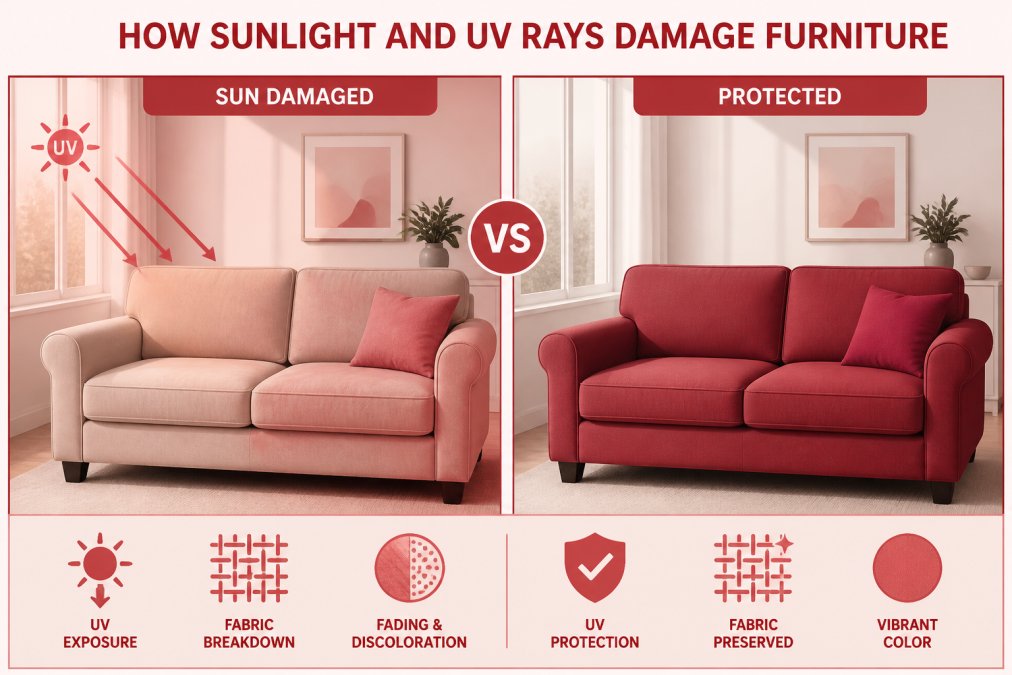
UV rays penetrate fabric, wood, and leather, breaking the chemical bonds that hold color pigments together.
Heat compounds the problem: direct sunlight dries materials, stiffening leather, warping wood, and making upholstery fibers brittle and prone to tearing.
The damage is cumulative and permanent, you can't reverse fading once it happens, so prevention matters more than repair.
How to Protect Wooden Furniture From the Sun
Wood is especially vulnerable: UV light breaks down lignin, the polymer that binds wood fibers and gives them their warmth. Once lignin degrades, the wood turns gray, the grain lifts, and no polish brings the color back. Stain and varnish fade too, and the surface can develop hairline cracks as the wood shrinks and swells unevenly.
Protecting wooden furniture requires blocking sunlight and protecting the finish itself.
Matching the Coating to the Wood and the Piece
The wrong finish can discolor wood, trap moisture, or fail within a season.
- Oil-based polyurethane, Best for oak, ash, maple, and other tight-grained hardwoods in daily use. It builds a hard, clear film and resists yellowing better than water-based formulas on light woods. On very light woods like birch or holly, however, it can amber over time, so test first.
- Water-based polyurethane, Stays clear on pale woods and dries fast with low odor. It's less durable than oil-based and can raise the grain, so sand lightly between coats.
- Spar varnish (marine-grade), The most UV-resistant clear finish commonly available. It contains UV inhibitors and stays flexible, suiting pieces near windows that see temperature swings. Inspect annually and reapply every one to three years in direct sun.
- Penetrating oil (tung, linseed, Danish), Soaks into the wood rather than sitting on top. It won't peel or crack, but offers the least UV protection and needs frequent refreshing. Best for low-exposure pieces or as a base under wax.
- Paint, Blocks essentially all light from reaching the wood. Exterior-grade acrylic or alkyd paint is the most durable choice for sunny rooms; interior paint chalks and fades faster under UV.
Applying Coatings Without Causing New Problems
A quality coating creates a UV barrier, but application errors often cause more damage than the sun.
- Sand to 150-220 grit, then wipe with a tack cloth; dust under a clear coat looks like grit trapped in glass.
- Test on a hidden area, the underside of a tabletop or the back of a leg, and let it cure 48 hours before judging color shift.
- Apply thin, even coats. Thick coats trap solvent, cure unevenly, and crack. Two to three coats is standard; spar varnish often needs four to six.
- Sand lightly between coats with 320-grit so the next coat has something to bite into.
- Respect recoat windows: most polyurethanes require a recoat within 2-24 hours or a full sanding.
Reapply film finishes every two to three years in direct sun; oiled finishes need refreshing every three to six months. Test by dripping water on the surface: if it beads, the finish is intact; if it soaks in or darkens the wood, recoat.
Positioning and Rotating Wooden Pieces
Moving furniture away from direct sunlight is the simplest protection, even a few feet measurably reduces the UV reaching the surface. Rotate pieces every few months to distribute fading evenly; a chair facing the window for six months will show uneven color loss if you never turn it.
Corner placement works well for valuable pieces, since corners receive less direct sun than center walls.
How to Keep Living Room Furniture From Fading
Living rooms often get the most sunlight, with sofas, chairs, and tables in positions where exposure is hard to avoid.
Using Curtains, Blinds, and Shades
Window treatments are your first line of defense, blocking sunlight before it reaches your furniture.
Heavy, lined curtains block nearly all direct light and add privacy and energy efficiency, though they darken rooms significantly.
Sheer curtains reduce glare and UV exposure while maintaining natural light, but won't fully protect furniture in intense sun.
Cellular shades combine privacy, light control, and insulation, trapping air to regulate temperature while blocking UV rays effectively.
The best choice depends on your room:
- High-traffic areas that need light: sheer curtains or adjustable blinds
- Rooms where you want complete protection: heavy lined curtains
- Spaces that need temperature control: cellular shades
- Bedrooms and private spaces: any option works
Leave window treatments closed during peak sun hours. Morning and evening light is less damaging than midday rays.
Covering Furniture With Protective Materials
Furniture covers are a simple, flexible solution for when you're away or during seasons of heavy sun exposure.
Cotton blankets and sheets work in a pinch because they're breathable; avoid plastic covers, which trap heat and damage finishes.
Fitted covers for sofas and chairs stay in place and look intentional; canvas covers are durable and allow air circulation.
Covers work best when:
- You're not using the furniture regularly
- You're storing pieces seasonally
- You want to protect valuable or antique items
- Sunlight exposure is seasonal
Remove covers periodically to check for moisture buildup. Ventilation prevents mold and mildew.
UV Window Film for Furniture Protection
UV window film is a thin, adhesive-backed polyester layer applied to glass. It blocks the ultraviolet portion of sunlight while letting most visible light through, so a room stays bright while the rays that fade fabric and crack finishes are largely filtered out.
What Film Actually Blocks, and What It Doesn't
Most quality films block up to 99% of UV radiation in the 300-380 nanometer range, the band responsible for most fading and material degradation.
What the headline number does not tell you:
- Visible light and heat still pass through. UV is only one part of sunlight; visible light and infrared cause their own fading and heat damage. A clear UV film blocks UV but does little for glare or heat.
- Fading is not caused by UV alone. Visible light, heat, humidity, and the dyes in the material itself all contribute. Film reduces one major factor; it does not stop fading entirely.
- Film performance degrades. Cheaper films can bubble, peel, or turn purple within a few years. Premium films typically carry warranties in the 10-year to lifetime range, but installation quality drives real-world lifespan.
Comparing Film to Curtains, Blinds, and Shades
Here is how film stacks up against the main alternatives.
| Option | UV Reduction | Visible Light Impact | Privacy | Installation | Maintenance |
|---|---|---|---|---|---|
| UV window film | Up to ~99% | Low to moderate, depending on tint | None to moderate | Professional recommended | Wipe with mild soap; avoid abrasives |
| Heavy lined curtains | High when closed | Large, darkens room | High when closed | DIY | Dry clean or wash per fabric |
| Sheer curtains | Low to moderate | Minimal | Low | DIY | Frequent washing |
| Horizontal or vertical blinds | Moderate, adjustable | Adjustable | Moderate to high | DIY | Dusting and occasional deep clean |
| Cellular shades | Moderate to high | Adjustable | Moderate to high | DIY | Dusting; some are spot-clean only |
| Exterior shade or awning | High | Moderate | High | Professional for permanent installs | Seasonal inspection |
Film's advantage is that it works continuously without daily adjustment and preserves your view. Its disadvantage is that it is essentially permanent, removal is difficult, can leave adhesive residue, and on some older or low-E glass can damage the glazing or void the window's warranty.
Choosing the Right Film
- Clear UV film, Maximum light, maximum UV rejection, no privacy. Best for rooms where you want to keep the view and natural brightness.
- Tinted or dyed film, Adds glare and heat reduction at the cost of visible light. Good for west- and south-facing rooms that overheat.
- Ceramic film, Blocks UV and infrared with minimal visible-light loss and no metallic interference with cell or Wi-Fi signals. Higher cost, better performance.
- Security film, Thicker and designed to hold glass together on impact. UV performance varies; not all security films are UV-rated.
- Decorative or frosted film, Provides privacy and some UV reduction. Best for bathrooms, sidelights, and street-facing windows.
Installation and Long-Term Care
Professional installation is worth the cost on large or hard-to-reach windows: proper prep, cleaning the glass, trimming the film, and squeegeeing out moisture, determines whether it looks invisible or bubbles and lifts within a year.
After installation, wait at least 30 days before cleaning. Use a soft cloth and mild soap-and-water solution; avoid ammonia-based cleaners, paper towels, and abrasive pads, which scratch the coating.
Film works best for large windows with consistent sun exposure, rooms where you want natural light, and hot climates where heat reduction is a bonus.
Assessing Sun Exposure in Your Home
Before choosing protection methods, evaluate your sun exposure. Different rooms need different approaches.
Track sunlight patterns for a few days. Note which areas get direct sun and when.
Room orientation matters:
- North-facing rooms get minimal direct sun
- South-facing rooms get intense, all-day sun
- East-facing rooms get strong morning sun
- West-facing rooms get intense afternoon sun
Window size and placement matter: large south-facing windows deliver more UV than small north-facing ones.
Nearby trees and buildings create shade. Shade from trees changes seasonally. Buildings provide consistent shade.
Use this assessment to prioritize.
Repairing and Restoring Sun-Damaged Furniture
Some damage is permanent, but you can minimize its appearance.
For faded wood, refinishing is best: sand away the damaged surface layer, then apply new stain and protective coating.
Cracked leather can be repaired with leather filler and dye. Small cracks disappear. Large cracks are harder to hide.
Prevention is always cheaper than repair, so protect furniture from sun damage from the start.
Protecting your furniture from sun damage doesn't require complex solutions. Whether you choose Residential Window Tinting to block harmful UV rays while maintaining your home's natural light and views, curtains, or repositioning, the key is starting before damage occurs.
| Protection Method | Best For | Effort Level |
|---|---|---|
| Window film | Permanent, all-day protection | Professional installation |
| Curtains or blinds | Light control and flexibility | Easy adjustment |
| Furniture covers | Seasonal or temporary protection | Simple storage |
| Protective coatings | Wood furniture preservation | One-time application |
| Furniture repositioning | No-cost adjustment | Minimal effort |
Frequently Asked Questions
What is the best way to protect indoor furniture from fading?
Combine multiple strategies for maximum protection. Use UV-blocking window film or quality curtains and blinds to reduce direct sunlight exposure. Rearrange and rotate furniture periodically to distribute sun exposure evenly. For valuable pieces, apply protective coatings suited to the material, varnish or polyurethane for wood, specialized leather conditioners for upholstered items. Move high-value furniture away from south and west-facing windows where UV rays are strongest.
Do window films help protect furniture from sun damage?
Yes, UV window films are highly effective. They block 99% of harmful ultraviolet light while allowing visible light through, reducing fading without darkening your rooms significantly. Window films work continuously without requiring adjustment, unlike curtains or blinds. They also reduce heat and glare, improving comfort and energy efficiency. Professional installation ensures proper coverage and longevity, with premium films typically carrying warranties in the 10-year to lifetime range.
How often should I rotate furniture to prevent uneven fading?
Rotate furniture every 6 to 12 months, depending on sun exposure intensity. Rooms with strong afternoon sunlight or large windows may need quarterly rotations. This distributes UV exposure evenly across all surfaces, preventing the dark patches and color variations that occur when furniture sits in the same spot for years. Rearranging also helps protect floors and other furnishings from uneven fading patterns.
Can UV-protective coatings help protect furniture from sunlight?
Yes, protective coatings add a barrier between furniture surfaces and UV rays. For wooden furniture, polyurethane, varnish, and specialized UV-blocking stains offer lasting protection while preserving the wood grain and finish. For upholstery and fabric, UV-resistant treatments can be applied during manufacture or professionally after purchase. Coatings work best when combined with reduced direct sunlight exposure through window treatments or strategic furniture placement.