 how-to
How to Choose Commercial Window Film: A Selection Guide
Table of Contents
- Understanding Commercial Window Film and Its Purpose
- Types of Commercial Window Film and Their Applications
- Commercial Window Film for Heat Reduction
- Commercial Window Film for Glare Reduction
- Key Performance Metrics and Specifications to Compare
- Commercial Window Film Installation: What to Expect
- Decision Framework: Matching Building Needs to Film Type
- Questions to Ask Your Window Film Installer
- Frequently Asked Questions
Last Updated: October 17, 2026
Understanding Commercial Window Film and Its Purpose
Commercial window film is a thin, adhesive layer applied to glass in commercial buildings to reduce heat, block UV rays, improve privacy, and enhance security. At Signs and Window Tinting LLC, we help property managers and business owners choose film that improves comfort, energy costs, and aesthetics through our Commercial Window Tinting services.
The film reflects and absorbs solar energy before it enters your space, addressing heat gain, glare, fading, and glass-shatter vulnerabilities at once.
Most commercial properties struggle with one of three problems: energy costs and heat, glare and comfort, or security and privacy. The film you choose depends on which matters most.
Types of Commercial Window Film and Their Applications
Solar Control Film
Solar control film reduces heat and glare by blocking infrared radiation while allowing visible light through. It's the most common choice for warm climates or buildings with significant sun exposure.
Lighter tints block heat while maintaining clear views; darker tints reject more heat but reduce natural light. The choice depends on orientation and daylight goals.
Solar control film typically lasts 10-15 years with proper installation. It's ideal for:
- Office buildings with large south or west-facing windows
- Retail spaces where merchandise fading is a concern
- Warehouses and industrial facilities
Safety and Security Film
Safety film holds glass together if it breaks, preventing shards from scattering, protecting occupants from injury, and making forced entry significantly harder.
Security film is thicker and stronger than solar control film, designed to withstand impact and resist penetration.
The film doesn't prevent glass from breaking, but it keeps broken glass bonded to the frame, preventing injuries and deterring burglaries.
Privacy and Decorative Film
Privacy film blocks the view into your space while allowing light through. Decorative film adds branding, patterns, or frosted effects to glass surfaces.
Privacy film ranges from semi-transparent frosted looks to fully opaque options, while decorative film can display your logo, patterns, or custom graphics. These films hide interior activity, enhance branding, and reduce glare without darkening the space.
Commercial Window Film for Heat Reduction
Heat reduction drives most commercial window film installations. Excessive solar heat raises cooling costs, strains HVAC systems, and creates hot spots.
Commercial window film blocks 40-80% of solar heat depending on film type and darkness level, so your air conditioning doesn't work as hard and utility bills drop.
Heat rejection works through reflection and absorption: the reflective coating bounces heat away, while the absorptive layer re-radiates absorbed heat outward through the glass.
Commercial Window Film for Glare Reduction
Glare causes eye strain, headaches, lost productivity, merchandise damage, and unreadable displays. Commercial window film solves this by diffusing and absorbing incoming light.
Glare reduction doesn't require dark film: even light-tinted solar control film spreads light evenly instead of creating bright spots and shadows. The best anti-glare films reduce eye strain near windows, protect inventory from fading, keep screens readable, and maintain a professional appearance.
Key Performance Metrics and Specifications to Compare
Most film spec sheets look similar at a glance, so compare the same five or six numbers across every candidate product using manufacturer-published data, not verbal claims. Demand these metrics in writing.
Visible Light Transmission (VLT)
Visible Light Transmission (VLT) is the percentage of visible light that passes through the filmed glass. Higher VLT means a brighter interior and clearer views; lower VLT means a darker tint and more privacy.
VLT most affects how the building feels and photographs from the street. A film that hits heat numbers but drops VLT too far makes a storefront look closed and can trigger lighting-energy penalties as occupants turn on more interior lights.
Solar Heat Gain Coefficient (SHGC)
Solar Heat Gain Coefficient (SHGC) is the fraction of incident solar energy that enters the building as heat, expressed as a number between 0 and 1. Lower is better for cooling-dominated buildings. Unfilmed clear single-pane glass is often around 0.7-0.8; a good solar-control film can bring the filmed assembly down into the 0.2-0.4 range.
Total Solar Energy Rejected (TSER)
Total Solar Energy Rejected (TSER) is the complement of SHGC expressed as a percentage: the share of total solar energy the filmed glass keeps out, combining reflection, absorption, and re-radiation. An 80% TSER film rejects roughly 80% of incident solar energy. Read TSER alongside SHGC and VLT, since high TSER with very low VLT may simply be a very dark film.
Glare Reduction
Glare reduction is reported as a percentage relative to unfilmed glass, calculated from the change in VLT. A film cutting VLT from 70% to 35% delivers roughly 50% glare reduction. Offices with screens near windows want meaningful glare reduction without a dim space; retail may tolerate darker film to protect merchandise.
Ultraviolet (UV) Rejection
UV rejection is the percentage of ultraviolet radiation blocked by the filmed glass. Quality commercial films typically block 99% of UV up to about 380-400 nanometers regardless of tint. UV is the primary driver of fading and color shift, so confirm the specific wavelength range tested rather than accepting a generic "99% UV" claim.
Reading the Numbers Together
The metrics interact, and the trade-offs are the point:
- High VLT + low SHGC is the spectrally selective sweet spot: bright interior, strong heat rejection. Costs more per square foot but worth it where daylight and views matter.
- Low VLT + low SHGC is classic dark solar film: maximum heat and glare control, dimmer space, more noticeable exterior.
- High VLT + higher SHGC is a light, nearly clear film: modest heat reduction, good for cool climates or north-facing glass.
A Note on Test Standards
Performance numbers are only comparable under the same test framework. In the U.S., filmed-glass performance is commonly reported using National Fenestration Rating Council (NFRC) conventions for VLT, SHGC, and U-value, and films are often tested under ASTM methods for adhesion, optical properties, and weathering. When spec sheets disagree, ask whether both were generated under NFRC-style conditions on comparable glass; if not, it's not apples to apples.
What to Put in Your Comparison Spreadsheet
Before requesting quotes, build a grid with one row per candidate film and columns for product name, VLT, SHGC, TSER, glare reduction, UV rejection, warranty length, and installed price per square foot. Require every bidder to fill the same columns. This separates real products from marketing and gives you a defensible record if performance falls short.
Commercial Window Film Installation: What to Expect
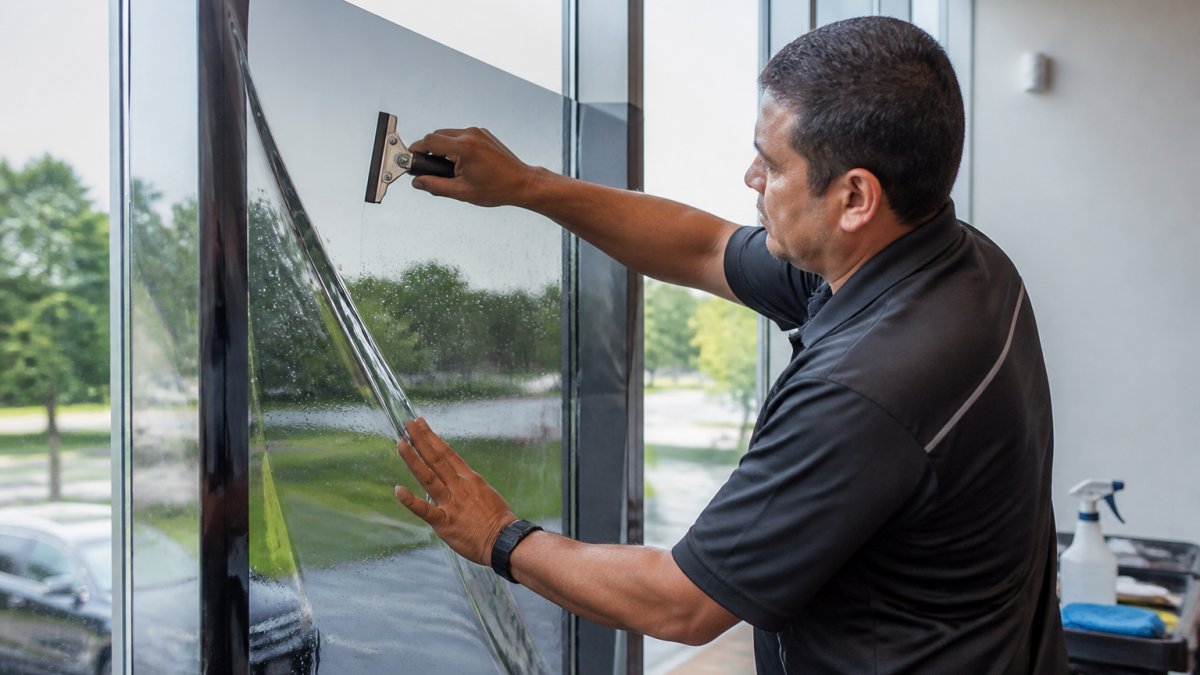
Professional installation takes 1-3 days depending on building size and window count: cleaning glass, cutting film to size, applying adhesive, and smoothing out air bubbles. Disruption is minimal, as most installers work one section at a time so operations continue elsewhere. The film cures over 24-48 hours, during which windows shouldn't be cleaned or exposed to excessive moisture.
After installation, expect:
- 24-48 hour cure time before cleaning windows
- Slight haze that clears as adhesive cures
- Full performance benefits within one week
Decision Framework: Matching Building Needs to Film Type
The fastest way to choose commercial window film is to start with the building's actual problem, not the product category. The matrix below maps common symptoms to the film family, metrics to prioritize, and trade-offs to accept. Use it to narrow the field to two or three candidates, then compare them on the specification sheet.
Needs-to-Product Matrix
| Building problem | Primary film family | Metrics to prioritize | Main trade-off |
|---|---|---|---|
| High cooling bills, hot perimeter zones | Solar control (spectrally selective where daylight matters) | Low SHGC, high TSER, VLT matched to daylight goals | Darker films reject more heat but reduce daylight and views |
| Glare on screens, eye strain, washed-out displays | Solar control or glare-reduction film | Glare reduction percentage, VLT | Aggressive glare control can make the space feel dim |
| Fading of merchandise, furnishings, artwork | UV-blocking solar control film | UV rejection (confirm wavelength range), VLT | UV protection alone does not stop all fading; visible light and heat also contribute |
| Break-in risk, glass-shatter injury, storm exposure | Safety and security film (often thicker, sometimes with attachment systems) | Impact performance, adhesion, edge retention | Thicker security film can change appearance and may need frame attachment for full performance |
| Street-level visibility, brand graphics, privacy | Privacy and decorative film | Frost level, opacity, print durability | Privacy film can block views occupants want; decorative film needs design approval |
| Mixed problems (heat + security + branding) | Layered or combined systems, or film on selected elevations only | Balanced VLT/SHGC plus impact rating | Cost rises quickly; prioritize elevations by problem severity |
Step 1: Diagnose by Elevation, Not by Building
Most buildings have four facades with different problems: a west-facing lobby may overheat while north-facing offices are comfortable and the ground-floor storefront needs security film. Walk the building with an elevation map and note, for each side, sun exposure, hours of direct sun, occupant complaints, merchandise at risk, and security concerns.
Step 2: Weigh Climate and Orientation
Climate and orientation determine whether heat rejection is a net benefit or cost:
- Cooling-dominated climates (hot summers, mild winters): prioritize low SHGC and high TSER; cooling-season savings dominate, and modest winter heat loss is a small penalty.
- Heating-dominated climates (cold winters, mild summers): be cautious with very dark, high-absorption films. Winter solar gain through south-facing glass is free heat, so light, spectrally selective films or filming only west and east elevations is often better.
- Mixed climates: film west and south elevations where summer overheating is worst, leaving north-facing glass lightly filmed or unfilmed.
Step 3: Run a Simple Payback Estimate
General "up to 30% savings" claims are not a decision tool. A defensible payback estimate uses four inputs:
- Installed cost: film plus labor, quoted per square foot of filmed glass. Get at least two itemized quotes.
- Filmed glass area: measure the panes you plan to film, not the whole envelope.
- Estimated cooling savings: ask for a modeled reduction in cooling load for the specific elevations, or use a conservative range and stress-test it.
- Local electricity rate: use your actual utility rate, including demand charges, not a national average.
Payback in years is roughly installed cost divided by annual energy savings. If savings are uncertain, run the calculation at half the claimed figure and see whether the project still clears your hurdle rate. Filming only the worst elevations often produces a shorter payback than a whole-building project, even with a smaller headline savings number.
Step 4: Check Glass Compatibility Before You Commit
Tempered, annealed, laminated, and insulating glass units (IGUs) behave differently under film, and dark, high-absorption films on certain glass can create thermal stress that cracks panes or voids warranties. Before signing, confirm:
- Glass type and thickness for each filmed pane
- Whether the glass is part of an IGU, and whether the IGU manufacturer approves film
- Existing coatings or tints that may interact with the film
A reputable installer will inspect the glass and put compatibility in writing. If a bidder skips this step, treat it as a disqualifier regardless of price.
Step 5: Confirm Code and Building Requirements
Window film can intersect with safety glazing, fire, egress, accessibility, lease, and historic-preservation requirements. Verify with the authority having jurisdiction whether filmed glass must retain safety-glazing performance, whether film affects exit-path visibility, and whether exterior film triggers signage or design-review approval. Confirm locally rather than relying on a generic checklist.
A Quick Decision Sequence
For most commercial projects: map problems by elevation, weigh climate and orientation, shortlist two or three film families from the matrix, compare them on the specification sheet, run a conservative payback, confirm glass compatibility and code requirements, then select the installer. That order prevents the most common and expensive mistake: choosing a film before the building's actual problem has been defined.
Questions to Ask Your Window Film Installer
Before hiring an installer, ask these questions:
About their experience:
- How many commercial installations have you completed?
- What certifications or training do you have?
- Can you provide references from similar projects?
About glass compatibility:
- Will you inspect my glass before recommending a film?
- What happens if my glass isn't compatible with the film I want?
- Do you test for thermal stress risks?
About film selection:
- What film do you recommend for my specific building needs?
- How will you measure and compare SHGC, VLT, and UV protection?
- What's the expected lifespan of the film you're recommending?
About installation:
- How long will installation take?
- Will you protect my building's interior during installation?
- What's your cure time before I can clean windows?
About pricing and warranties:
- What's included in your quote (film, labor, cleanup)?
- How long is the manufacturer warranty?
- What does the warranty cover and exclude?
At Signs and Window Tinting LLC, we answer every question thoroughly and provide detailed inspections before recommending any film. Our 35+ years of experience means we've handled every building type and glass configuration.
Choosing the right commercial window film requires understanding your building's primary challenge, comparing specifications carefully, and working with an experienced installer. Get a free quote from Signs and Window Tinting LLC and let our team inspect your windows, assess your needs, and recommend the film that delivers the results you need.
Frequently Asked Questions
What is the difference between automotive tint and commercial window film?
Automotive tint is designed for vehicle windows and prioritizes aesthetics and heat rejection in smaller applications. Commercial window film is engineered for larger flat glass surfaces, building codes, and thermal stress considerations. Commercial film typically offers higher UV rejection rates, better glare control, and thicker construction to meet safety standards. The installation process also differs: commercial film requires professional assessment of glass type, orientation, and building compliance.
How do I choose commercial window film for heat reduction?
Evaluate solar heat rejection (the percentage of solar energy the film blocks) and visible light transmission (how much natural light passes through). For maximum heat reduction, choose films with high solar heat rejection (typically 50-80%) paired with your building's orientation and climate. Consider glass compatibility and thermal stress risk, especially on south and west-facing windows. Consult with an installer about your specific window type and building needs to avoid warranty exclusions.
How long does commercial window film last?
Quality commercial window film typically lasts 10-20 years with proper maintenance and professional installation. Durability depends on film quality, glass type, building orientation, and climate exposure. UV-stable films resist fading better than budget alternatives. Manufacturer warranties usually cover 5-10 years against peeling, bubbling, and delamination when installed by authorized professionals. Regular cleaning with appropriate methods extends performance and helps identify maintenance needs early.
What should I consider before installing window film on commercial glass?
Assess your glass type (tempered, laminated, or standard), window orientation, and thermal stress risk. Verify that the film meets building codes and doesn't void existing glass warranties. Consider interior visibility needs, occupant comfort, and energy efficiency goals. Evaluate the building's climate, seasonal sun exposure, and HVAC capacity. A professional installer should inspect all windows and recommend compatible films. Factor in lifecycle costs, including installation, maintenance, and potential energy savings over 10-15 years.