 blog
Commercial Window Film for Heat Reduction: 2026 Guide
Table of Contents
- Why Commercial Window Film for Heat Reduction Is a Smart Investment
- Key Performance Metrics: SHGC, VLT, and Infrared Rejection
- Commercial Window Film Energy Savings: What to Expect
- UV Protection, Fading, and Interior Furnishings
- How Long Does Commercial Window Film Last?
- The Commercial Window Film Installation Process
- Building Codes, Compliance, and ROI: What Facility Managers Should Know
- Frequently Asked Questions
Last Updated: September 16, 2026
Why Commercial Window Film for Heat Reduction Is a Smart Investment
Commercial window film for heat reduction is a thin, professionally applied layer that blocks solar energy before it enters a building, cutting cooling demand without replacing existing glass. At Signs and Window Tinting LLC, we have watched this shift firsthand since 1992: tenants stop complaining about hot conference rooms, and utility spikes flatten out.
How Window Film Blocks Solar Heat
Solar radiation arrives as visible light, infrared, and ultraviolet. Metallized and ceramic layers reflect infrared back outside, while spectrally selective coatings reject heat without turning the room into a cave.
- Reflective films bounce a high share of solar energy away
- Ceramic films reject infrared while preserving optical clarity
- Hybrid films balance heat rejection with visible light transmission
Key Performance Metrics: SHGC, VLT, and Infrared Rejection
Three numbers decide whether a film solves your problem: SHGC, VLT, and infrared rejection. Read them together: excellent heat rejection with poor VLT darkens your space, while high VLT with weak SHGC will not move utility costs.
| Metric | What It Measures | Typical Range | Why It Matters |
|---|---|---|---|
| SHGC | Total solar heat admitted | 0.20-0.60 | Lower means less cooling load |
| VLT | Visible light transmitted | 5%-70% | Controls daylight and glare |
| Infrared rejection | IR energy blocked | 40%-95% | Direct heat reduction |
| UV rejection | Ultraviolet blocked | Up to 99% | Protects furnishings and skin |
Solar Heat Gain Coefficient (SHGC) Explained
Solar heat gain coefficient (SHGC) is the fraction of solar energy that passes through a window as heat, expressed as a number between 0 and 1. A lower SHGC means less heat enters the building. The DOE window performance guidance treats SHGC as the primary metric for cooling-dominated climates, and for good reason: it captures the full heat picture, not just one wavelength.
Visible Light Transmission and Glare Reduction
Visible light transmission (VLT) is the percentage of daylight passing through the glass. Glare reduction follows from lowering VLT, which is why monitor-heavy offices benefit most. Drop VLT too far, though, and you trade headaches for a dim workspace; daylight harvesting systems also lose efficiency below roughly 20% VLT.
Commercial Window Film Energy Savings: What to Expect
Commercial window film energy savings depend on four measurable variables: climate zone, glass-to-wall ratio, existing glazing performance, and building operation. The biggest mistake is treating savings as a single percentage, they scale with the solar gain you eliminate, multiplied by glass square footage, multiplied by cooling hours.
The Four Variables That Drive Savings
- Climate zone. Cooling-dominated climates reward aggressive SHGC reduction; heating-dominated climates require balancing winter solar gain against summer rejection.
- Glass-to-wall ratio. A curtain-wall office with 60% glazing has far more savings potential than a warehouse with punched windows.
- Existing glazing. Single-pane clear glass is the highest-yield retrofit target. Low-E double-pane glass narrows the delta.
- Operating schedule. A building running cooling 12 hours a day captures more savings than one running 8.
Where the Savings Actually Land on the Bill
Most of the financial benefit shows up in three places:
- Reduced cooling kWh during occupied hours
- Lower peak demand charges, the largest lever on demand-based rate structures, because film cuts afternoon solar load precisely when demand peaks
- Deferred HVAC capital, a chiller no longer maxed out lasts longer and can be downsized at replacement
A Simple Savings Estimation Framework
You do not need an engineering study for a defensible estimate:
- Pull 12 months of utility bills and isolate the cooling portion (kWh plus demand charges)
- Estimate the share of cooling load from solar gain through glass, facade orientation and glazing area drive this
- Apply the expected SHGC reduction from the film's data sheet
- Multiply by the cooling portion for projected annual savings
- Divide installed cost by annual savings for payback in years
What Changes the Numbers Most
Expect the strongest results where:
- Glazing area is large relative to floor area
- The building runs cooling year-round
- Peak demand charges dominate the utility bill
- The glass is single-pane or older dual-pane without a low-E coating
The DOE Building Technologies Office notes that windows account for a significant share of a building's heating and cooling energy, which is why even modest SHGC improvements compound across a large facade. The math is not complicated, it is just frequently skipped.
UV Protection, Fading, and Interior Furnishings
Ultraviolet rays cause most fading damage to upholstery, carpet, artwork, and wood finishes. Window film blocks up to 99% of UV radiation, slowing that degradation. For facilities with expensive furnishings or retail merchandise on display, the protection pays for itself in avoided replacement costs.
How Long Does Commercial Window Film Last?
Commercial window film typically lasts 10 to 20 years when professionally installed and maintained. Lifespan depends on film quality, sun exposure, and, most underestimated, how the glass is cleaned. Cheap films applied by untrained hands often fail within a few years, bubbling, peeling, or turning purple.
Warranty Coverage and What It Actually Covers
Reputable manufacturers back films with warranties covering adhesion, discoloration, and bubbling, but coverage varies widely:
- Adhesion and bubbling, usually covered for the full warranty term
- Discoloration, often covered, but some warranties exclude color shift below a threshold
- Glass breakage, rarely covered, and only on specific film-glass combinations
- Labor, frequently excluded, meaning you pay for reinstallation even on a covered film
Cleaning Protocols That Protect the Film
This is where most premature failures originate: cleaning crews using the same products they always have, which damage film.
Do:
- Clean with a mild, ammonia-free solution, a few drops of dish soap in water works
- Use a soft cloth, microfiber, or a squeegee with a clean rubber blade
- Rinse the glass first to lift grit before wiping
- Work top to bottom and dry the edges last
Do not:
- Use ammonia-based glass cleaners, ammonia degrades the adhesive over time
- Use abrasive pads, scouring powders, or razor blades
- Use vinegar or acidic cleaners
- Let cleaning solution pool at the film edge where it meets the frame
- Scrape near edges where the film meets the frame
A Maintenance Schedule for Facility Managers
Build film care into your existing window cleaning contract:
- Confirm the cleaning contractor uses ammonia-free products, in writing
- Inspect edges annually for lifting, especially south and west elevations
- Check for bubbling or hazing after the first summer
- Document installation date, film spec, and warranty terms per elevation
- Photograph any defect before filing a warranty claim
- Re-inspect after glass replacement or exterior work near the facade
When Film Needs Replacing
Film does not fail all at once. Watch for these signals that a section is nearing end of life:
- Edge lifting that progresses past the frame line
- Bubbling that does not clear after curing
- Purple or hazy discoloration across a pane
- Adhesive failure visible as a cloudy border
The Commercial Window Film Installation Process
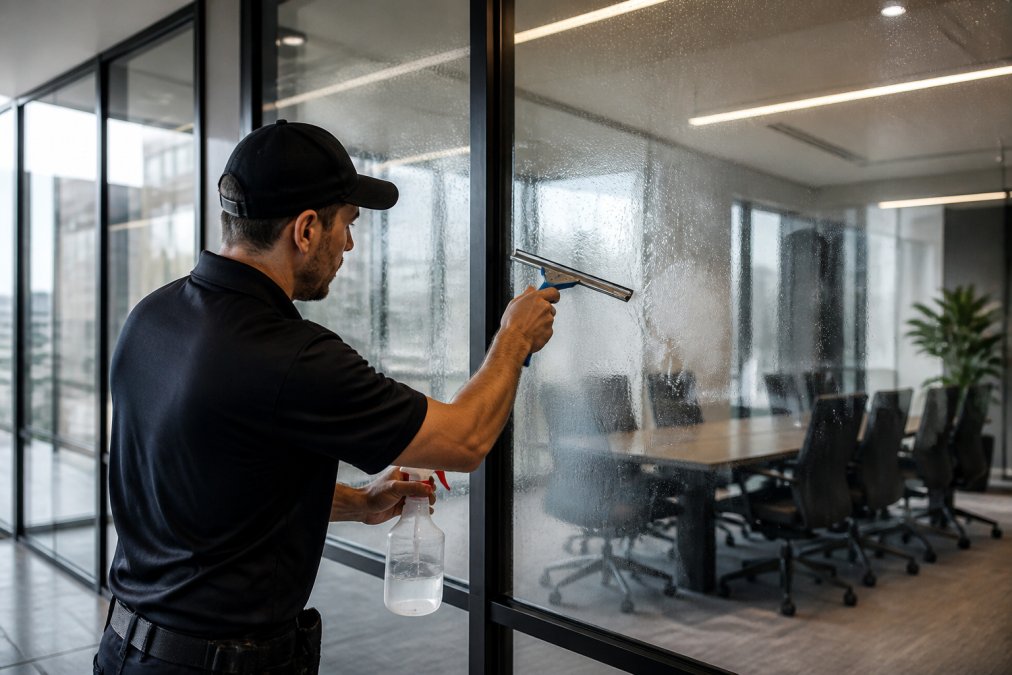
Professional installation follows a defined sequence, and skipping steps causes failures. It starts with a site survey: measuring glass area, identifying glass type, and checking for existing tint or damage. The crew then cleans each pane, applies a slip solution, positions the film, squeegees out moisture, and trims edges.
Building Codes, Compliance, and ROI: What Facility Managers Should Know
Building codes increasingly reward envelope improvements, and window film can help a facility move toward compliance without a full glazing replacement. Check local energy code requirements for your jurisdiction, since SHGC and VLT limits vary by climate zone and building type. The DOE Building Energy Codes Program maintains current code references by state.
Calculating Your Payback Period
Payback period is project cost divided by annual energy savings:
- Pull 12 months of utility bills and isolate cooling costs
- Estimate the share attributable to solar gain through glass
- Apply the expected SHGC reduction from your chosen film
- Divide installed cost by projected annual savings
A simple framework:
| Input | How to Get It | Example |
|---|---|---|
| Installed cost | Quote from installer | Project total |
| Annual cooling spend | Utility bills | Cooling portion only |
| Solar gain share | Engineering estimate | Facade-dependent |
| Projected reduction | Film spec data | SHGC improvement |
| Payback | Cost ÷ annual savings | Years to break even |
Frequently Asked Questions
What is the best window film to prevent heat buildup?
The best film depends on your priorities. For maximum heat rejection, look for a spectrally selective film with a low solar heat gain coefficient (SHGC) and high infrared rejection. These films block heat without making the space dark. For buildings with excessive glare, a slightly higher VLT film balances comfort and visibility. Signs and Window Tinting LLC can recommend the right film based on your glass type, orientation, and climate.
Does commercial window film really reduce heat?
Yes. Window film works by reflecting or absorbing solar radiation before it enters the building. A quality film can reject up to 80% of solar heat, reducing the load on your HVAC system. The exact reduction depends on the film's SHGC, your glass, and window orientation. In practice, many facility managers report noticeably cooler spaces and lower utility costs after installation.
What are the downsides of using window film?
Possible downsides include reduced visible light (depending on film darkness), potential interference with some wireless signals, and the need for professional installation to avoid bubbling or peeling. Low-quality films can fade or turn purple over time. Choosing a premium film with a strong warranty and hiring experienced installers, like those at Signs and Window Tinting LLC, minimizes these risks.
How much energy can commercial window film save?
Energy savings vary by climate, building orientation, glass type, and HVAC efficiency. In cooling-dominated climates, window film can reduce cooling costs by 5% to 15% annually. The payback period often falls between two and five years. For a precise estimate, request a professional assessment that factors in your building's specific conditions.