 how-to
How Can You Improve Store Brand Visibility?
Last Updated: October 24, 2026
Quick Summary
To improve store brand visibility, use clear storefront signage, professional window graphics, custom business signs, strategic visual merchandising, and integrate your online presence with your physical store. These elements work together to stop foot traffic, communicate your brand consistently, and drive sales.
- Storefront signs must follow three rules: clarity readable in three seconds, contrast against backgrounds, and consistency with your brand identity.
- Window graphics should feature your strongest message, use brand colors, include a clear call to action, and change seasonally to signal an active business.
- Eye-level product placement drives sales faster than floor or above-head placement, and grouping related items increases basket size.
- Track foot traffic, monitor sales by product location, and survey customers about brand recognition to measure visibility effectiveness.
- Professional design and installation matter because DIY signage looks DIY, while professional signage signals a business that cares about its brand.
Table of Contents
- Why Store Brand Visibility Matters for Your Bottom Line
- Storefront Signage Ideas That Stop Foot Traffic
- Retail Window Graphics That Showcase Your Brand
- Custom Business Signs for Consistent Brand Messaging
- Retail Visual Merchandising to Drive In-Store Sales
- Connect Online Visibility to Store Brand Discovery
- Measure and Test Your Visibility Strategy
- Getting Professional Help for Your Brand Visibility
- Frequently Asked Questions
Why Store Brand Visibility Matters for Your Bottom Line
Store brand visibility directly affects whether customers walk through your door and what they buy once inside.
Visibility isn't just about looking good. It's about being found. A customer driving past your storefront should recognize your brand instantly.
At Signs and Window Tinting LLC, we've worked with local businesses for over 35 years. Strong brand visibility moves inventory. It builds customer loyalty.
The challenge most store owners face is this: they invest in product quality but neglect how the store itself communicates.
Here's what we'll cover: how to improve store brand visibility through storefront design, window graphics, custom signage, visual merchandising, and online-to-store integration.
Storefront Signage Ideas That Stop Foot Traffic
Your storefront sign is the single most important visual element. It's what stops people. It's what makes them notice you exist.
The best storefront signage ideas follow three rules: clarity, contrast, and consistency.
Clarity means someone driving past at 30 mph understands what you sell in under three seconds. No clever wordplay. No obscure fonts. Your business name, your category, and your value proposition should be instantly readable.
Contrast means your sign stands out against its background. Light text on light buildings disappears. Dark text on dark buildings disappears.
Consistency means your sign matches your brand identity. Your colors should match your other marketing. Your font should reflect your brand personality.
Consider these specific approaches: For deeper strategies on storefront signage, explore signs for small business storefronts.
- Monument signs work for businesses set back from the road. They're visible from a distance. They establish authority.
- Wall-mounted signs maximize visibility for street-facing storefronts. They draw the eye upward.
- Illuminated signs work 24/7. They're especially valuable in evening shopping hours.
- Channel letters allow individual letters to be lit. They create dimension and sophistication.
- Digital signs let you change messaging seasonally or daily. They create visual interest.
The mistake most store owners make is choosing a sign based on cost alone.
Retail Window Graphics That Showcase Your Brand
Your store windows are real estate. They're prime advertising space. Most retailers waste them.
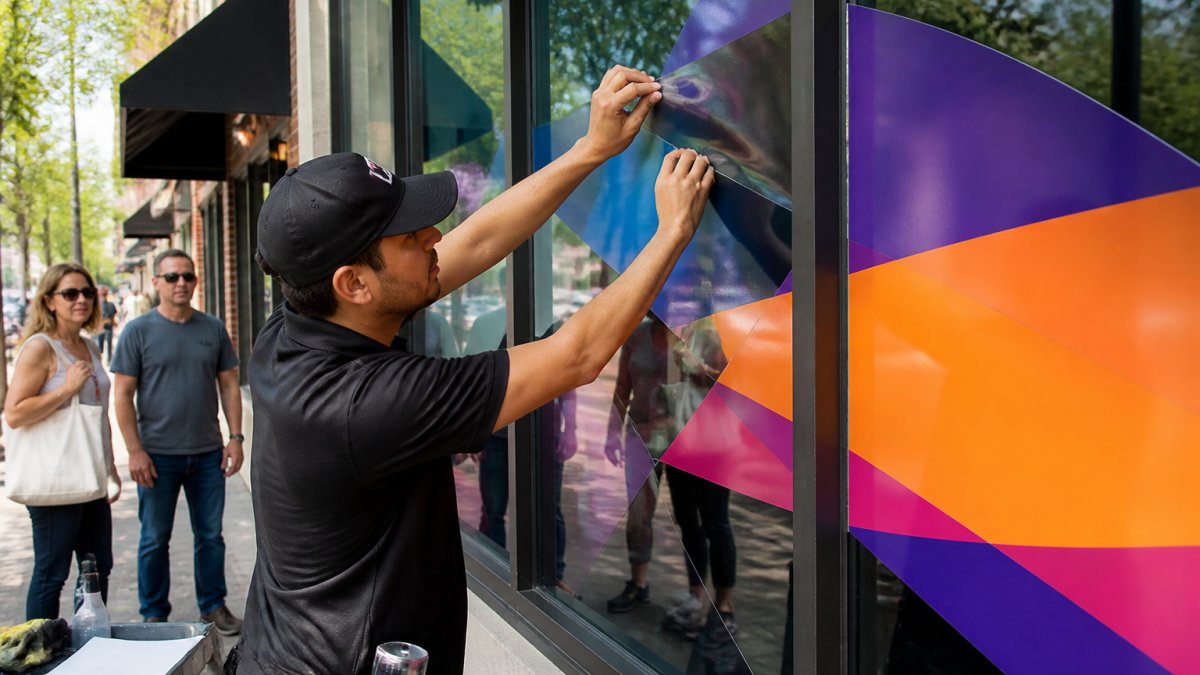
Window graphics serve two purposes: they communicate your brand identity, and they create visual interest that stops foot traffic.
The best retail window graphics follow these principles:
- Lead with your strongest message. If you're running a promotion, put it front and center. If you're launching a new product, feature it prominently.
- Use your brand colors. Consistency builds recognition. A customer should see your window and immediately know it's you.
- Include a clear call to action. "New arrivals inside." "Limited time offer." "Shop now." Tell people what to do next.
- Change seasonally. Stale window displays signal a stale business. Fresh graphics signal energy and relevance.
- Avoid clutter. One strong message beats five weak ones. White space is your friend.
Window graphics can showcase your brand in multiple ways: The same visual branding principles apply to vehicle lettering in Grandville, where professional vinyl graphics create consistent brand identity across all customer touchpoints.
- Product displays with lifestyle imagery
- Promotional messaging with your logo prominently featured
- Brand story graphics that communicate your values
- Seasonal themes that create urgency
- Customer testimonials or social proof
Many retailers underestimate the power of professional design. A DIY graphic often looks DIY. A professionally designed graphic looks like a business that cares. Customers notice the difference.
Custom Business Signs for Consistent Brand Messaging
Consistency is the foundation of brand recognition. When your signage is inconsistent, your brand is forgettable.
Custom business signs ensure every touchpoint communicates the same message. Your storefront sign matches your window graphics. Your interior signs match your exterior signs. Your vehicle lettering matches your store.
When a customer sees your brand in five different places, they remember it. They trust it. They choose it.
Here's why custom signage matters more than generic alternatives:
Generic signs look generic. They don't differentiate you. A custom sign built for your specific business, your specific location, and your specific brand identity is a competitive advantage.
Signs and Window Tinting LLC creates custom signs in Grandville that reflect your unique brand. We work with you to understand your brand identity, your target audience, and your business goals.
Custom signage decisions include:
- Material selection (metal, wood, acrylic, vinyl)
- Lighting options (illuminated, non-illuminated, backlit)
- Size and placement (storefront, interior, directional)
- Color and typography (matching your brand standards)
- Durability requirements (outdoor exposure, weather resistance)
The investment in custom signage pays dividends. It's not an expense.
Retail Visual Merchandising to Drive In-Store Sales
Once customers enter your store, visual merchandising determines what they buy.
Visual merchandising is the art of displaying products to maximize appeal and sales. It's not random arrangement. It's strategic placement designed to guide customer behavior.
The principles of effective visual merchandising include:
- Eye-level placement drives sales. Products at eye level sell faster than products at floor level or above head height. Reserve eye-level shelf space for your highest-margin items.
- Grouping related items increases basket size. Place complementary products together. A customer buying one item is more likely to buy the second if it's nearby.
- Color blocking creates visual interest. Arrange products by color. It's more appealing than random arrangement. It's also more memorable.
- Lighting highlights key products. Brighter lighting draws attention. Use it strategically on featured items.
- Seasonal displays create urgency. Customers respond to seasonal messaging. Update your displays quarterly.
- Cleanliness signals quality. A messy display signals a messy business. A clean, organized display signals professionalism.
In-store visibility strategies that work:
- Feature new products at store entrance
- Create promotional end-caps with high-margin items
- Use signage to highlight sales and special offers
- Arrange products to encourage store traffic flow
- Maintain consistent product placement so customers find items easily
Many retailers focus on inventory management and miss the visual merchandising opportunity. The same inventory arranged differently generates different sales. Strategic arrangement is a profit lever.
Connect Online Visibility to Store Brand Discovery
Your online presence drives store traffic. Your store visibility reinforces your online brand.
This connection works both ways. A customer discovers you online, then visits your store to see products in person. Or they see your storefront, then search for you online to learn more.
The integration between online and offline visibility includes:
- Local search optimization. Ensure your business appears in local search results. Use Google Business Profile. Include your store location, hours, and contact information (Add or claim your Business Profile). Encourage customer reviews.
- Social media location tags. When customers post about your store, tag your location. This builds social proof and drives discovery.
- QR codes in-store. Link from your physical signage to your online content. A customer can scan your storefront sign to see your website, menu, or product catalog.
- Consistent branding across channels. Your online brand should match your in-store brand. Same colors, same messaging, same values.
- Online-to-store promotions. Offer discounts for customers who mention your online content in-store. This tracks the connection and incentivizes visits.
- In-store-to-online promotions. Display QR codes in-store that link to exclusive online offers. This builds your email list and online engagement.
The brands that win are the ones that integrate online and offline visibility. They understand that modern customers move between channels. They make it easy to find them everywhere.
Measure and Test Your Visibility Strategy
You can't improve what you don't measure.
Most store owners have a gut feeling about what works. Gut feelings are often wrong. Data reveals the truth.
Here's how to measure store brand visibility:
Track foot traffic. Count how many people walk past your store daily. Count how many enter. Calculate your conversion rate. This baseline tells you if your visibility efforts are working.
Monitor sales by product location. Products at eye level should outsell products at other heights.
Measure signage effectiveness. Ask new customers how they found you. Did they see your storefront sign? Your window graphics? Your vehicle lettering?
Monitor online search traffic from your location. Use Google Analytics to see how many people search for your business by location. Track month-over-month growth.
Testing approaches that reveal what works:
- A/B test window displays. Change one display, track sales. Change it again, track sales again. Document which designs drive more traffic.
- Test signage placement. Move a sign to a different location. Measure foot traffic before and after.
- Test promotional messaging. Run different promotions in your window. Track which messaging generates more inquiries.
- Test visual merchandising layouts. Rearrange products. Track whether sales increase or decrease.
The businesses that win are the ones that test continuously. They measure results. They double down on what works. They eliminate what doesn't.
| Visibility Element | How to Measure | Success Indicator |
|---|---|---|
| Storefront signage | Foot traffic count, customer surveys | Increased daily foot traffic |
| Window graphics | Sales tracking by product, customer feedback | Higher conversion rate from foot traffic |
| In-store merchandising | Sales by shelf location, product movement | Eye-level products outsell other placements |
| Online-to-store connection | Google Analytics local search traffic | Month-over-month search growth |
| Brand recognition | Customer surveys, new customer source tracking | Customers mention your signage as discovery point |
Getting Professional Help for Your Brand Visibility
Implementing a visibility strategy takes expertise, design skill, and execution capability.
Many store owners try to do it themselves. They design their own signs. They arrange their own displays. The results look DIY. Customers notice.
Professional help matters because:
- Design expertise. A professional designer understands color theory, typography, and visual hierarchy.
- Brand consistency. A professional ensures all your signage communicates the same brand identity.
- Installation quality. A professional installs signage correctly. It stays up. It looks professional.
- Strategic guidance. A professional recommends which visibility channels will have the biggest impact for your specific business.
Signs and Window Tinting LLC has helped local businesses improve store brand visibility for over 35 years. We bring that experience to every project.
Schedule your project with us for a consultation. We'll assess your current visibility, identify gaps, and recommend specific improvements. We'll provide transparent pricing and timelines.
Your store brand visibility is too important to leave to chance. It's worth getting right.
Improving store brand visibility requires strategy, design, and execution.
Frequently Asked Questions
What does brand visibility mean for a store?
Brand visibility for a store means how easily and frequently customers notice your business, recognize your brand identity, and remember you compared to competitors. It combines physical presence (signage, window displays, storefront appearance) with online discovery (search rankings, social media, local listings). Strong brand visibility increases foot traffic, customer recognition, and sales because people buy from businesses they know and trust.
How can window graphics and signage improve store visibility?
Window graphics and signage act as your storefront's first impression and work 24/7 to communicate your brand message. Quality signage catches the eye of passersby, clearly identifies what your business does, and reinforces your brand identity. Custom window graphics can showcase products, promotions, or your brand story in a way that makes your store stand out from competitors on the same street. Professional installation ensures your message is readable, attractive, and aligned with your overall brand.
How can a store keep its branding consistent across signs and windows?
Consistency means using the same logo, colors, fonts, and messaging across all signage, window displays, and marketing materials. Develop brand guidelines that specify exact colors, approved fonts, logo placement, and tone of voice. Apply these rules to exterior signs, window graphics, interior displays, and digital platforms. Inconsistent branding confuses customers and weakens recognition; consistent branding builds trust and makes your store instantly recognizable.
What are the most effective ways to make a storefront stand out?
Effective tactics include: investing in high-quality, well-lit signage that's visible from a distance; using contrasting colors and clear fonts for readability; creating eye-level window displays that change seasonally or with promotions; keeping the storefront clean and well-maintained; adding professional window graphics that tell your brand story; ensuring your store appears in local search results and on Google Maps; and maintaining active social media presence to drive online-to-store traffic. The best results come from combining in-store visual appeal with strong online visibility.