 blog
Best Commercial Window Film Brands: 2026 Guide
Table of Contents
- What Makes a Commercial Window Film Brand Stand Out
- Commercial Window Film for Heat Reduction: Performance and Selection
- Film Types and Their Role in Commercial Performance
- Best Window Film for Commercial Buildings: Key Criteria
- Commercial Window Film Cost: Understanding Your Investment
- Commercial Window Film Warranty and Durability Expectations
- Glass Compatibility, Safety, and Code Compliance
- Choosing the Right Commercial Window Film Brand for Your Property
- Frequently Asked Questions
Last Updated: October 20, 2026
What Makes a Commercial Window Film Brand Stand Out
Commercial window film brands succeed when they solve real problems: reducing cooling costs, blocking UV that fades interiors, cutting glare, and improving security.
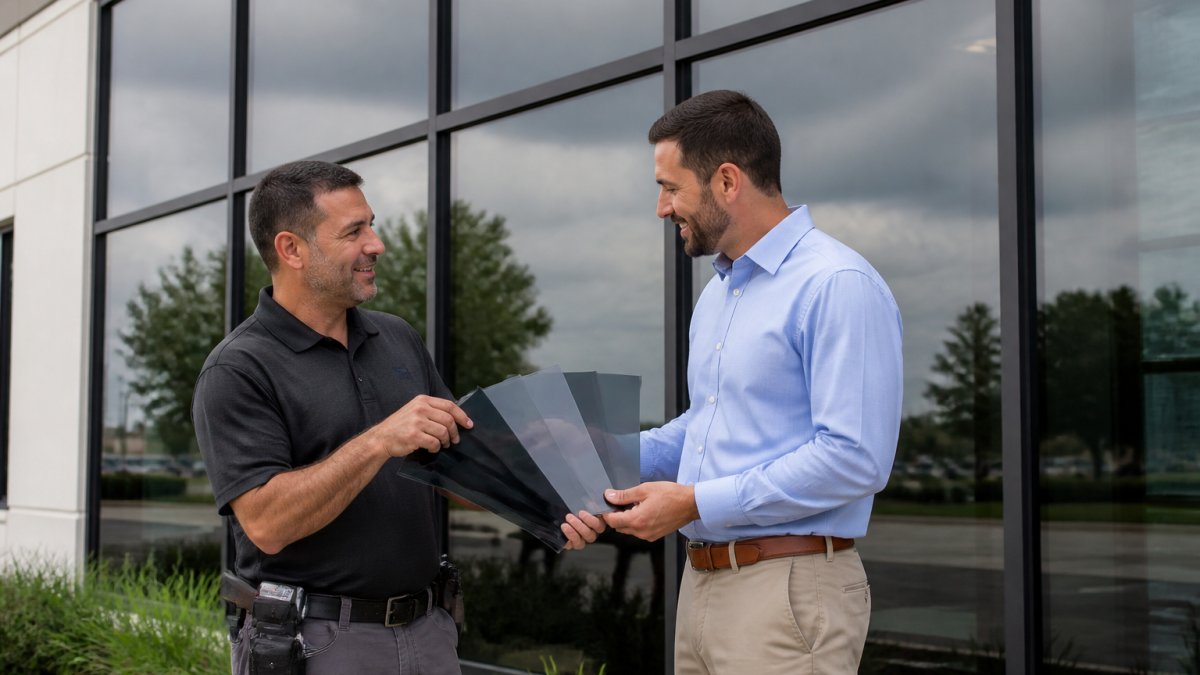
At Signs and Window Tinting LLC, we've worked with dozens of commercial properties across West Michigan, providing Commercial Window Tinting services alongside residential and automotive applications.
A quality commercial window film brand delivers measurable results: lower interior temperatures, reduced energy bills, and protection for furnishings and equipment.
Commercial Window Film for Heat Reduction: Performance and Selection
Heat rejection is the primary reason commercial buildings invest in window film.
The most effective commercial window film brands use spectrally selective technology, blocking infrared heat while allowing visible light through.
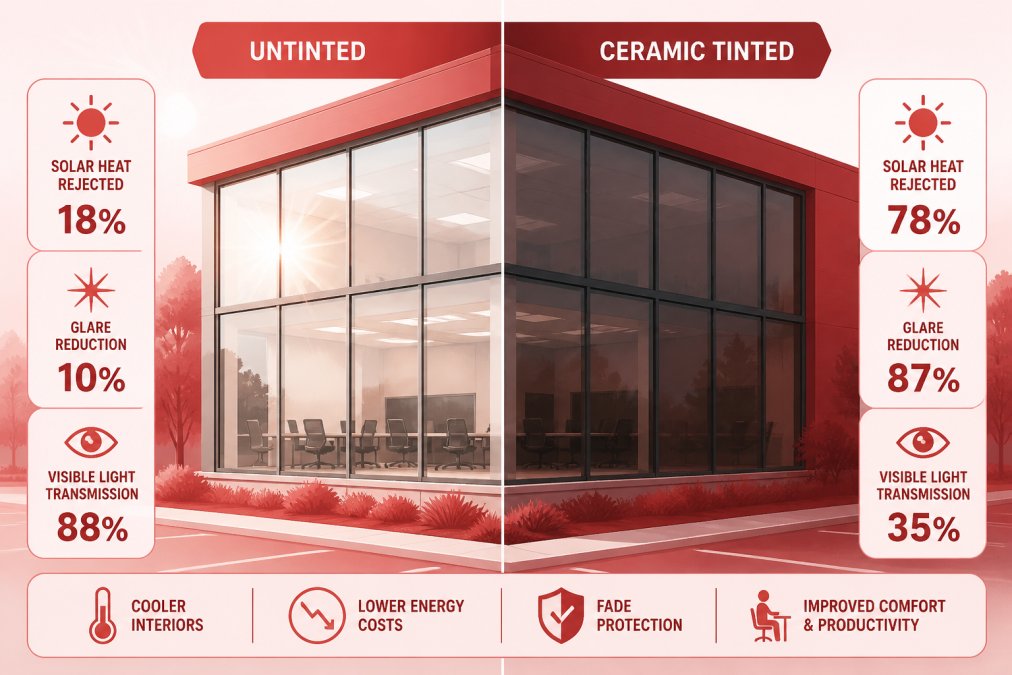
Carbon and ceramic films typically outperform dyed films for heat rejection in commercial applications, handling the thermal stress of large glass surfaces and maintaining performance over decades.
The best approach depends on orientation, glass type, and whether occupants need clear views.
Film Types and Their Role in Commercial Performance
Ceramic Films
Ceramic films use non-metallic particles to reject heat and UV without interfering with cell phones, WiFi, or other signals, making them ideal for offices with sensitive equipment.
The trade-off is cost. Ceramic films cost more than carbon or dyed options, but over a 15-20 year service life the annual cost becomes reasonable. They typically carry 10-15 year warranties covering discoloration and delamination.
Carbon and Dyed Films
Carbon films use carbon particles suspended in polyester layers, offering good heat rejection and UV protection at a lower price than ceramic. They're darker than ceramics at the same VLT, which some owners prefer for privacy or aesthetics.
Dyed films use organic dyes to absorb solar energy. They're the most affordable option but offer the least heat rejection and UV protection, fading over time, especially on south-facing windows.
Reflective and Spectrally Selective Films
Reflective films bounce solar radiation away, providing maximum heat rejection but a mirrored appearance some owners find unattractive. They can also create glare affecting neighbors, potentially violating local ordinances, so they work best on industrial or utility buildings where appearance is less critical.
Spectrally selective films block infrared wavelengths while transmitting visible light, maintaining clear views and a natural appearance. This technology offers the best balance of performance and aesthetics for most commercial applications, at a premium price that results justify.
Best Window Film for Commercial Buildings: Key Criteria
Solar Heat Gain Coefficient (SHGC) measures the fraction of solar radiation entering through the glass.
Visible Light Transmission (VLT) indicates how much natural light the film allows through.
UV Rejection should exceed 99% for all commercial applications, protecting furnishings, artwork, and employee skin.
Installation Quality matters as much as the film itself.
Warranty Coverage should include both film and labor for at least 10 years.
Commercial Window Film Cost: Understanding Your Investment
Commercial window film pricing is usually quoted per square foot of glass, installed, and the spread between low and high end is wide enough that a single "average price" is misleading.
What drives the installed price per square foot
- Film tier. Dyed and standard carbon films sit at the low end of the market; ceramic and spectrally selective films sit at the high end. Expect the film material alone to roughly double or triple between the cheapest dyed product and a premium ceramic product.
- Glass area and access. A single-story retail frontage with ground-level access is the cheapest geometry to film. Multi-story curtain walls, atriums, skylights, and windows above fixed seating or equipment require lifts, scaffolding, or out-of-hours work, and that labor premium can exceed the film cost itself.
- Glass condition and preparation. Painted frames, silicone residue, hard-water staining, and existing failed film all add prep time. Old film removal is typically billed separately and can approach the cost of a new installation on heavily degraded glass.
The whole-life cost math
The sticker price is only half the decision. What matters is cost per year of expected service life, net of energy savings.
A simple framework most practitioners use:
- Installed cost = film + labor + removal + mobilization.
- Expected service life = the manufacturer's warranty term, discounted for the reality that films rarely fail on day one of year 16. A 10-year warranty film and a 15-year warranty film should not be compared on sticker price alone.
- Annualized cost = installed cost ÷ expected service life.
- Annual energy benefit = the reduction in cooling load, converted to dollars at your utility rate.
- Simple payback = installed cost ÷ annual energy benefit.
A premium ceramic film costing more per square foot but carrying a 15-year warranty can easily have a lower annualized cost than a dyed film replaced twice in the same window. Run the math on your own glass area before assuming the low bid is the value bid.
How energy savings actually show up
Window film does not produce a single, clean line item on a utility bill. The savings appear as a smaller cooling load, which shows up as:
- Lower compressor run time and fewer peak-demand spikes in summer.
- Less strain on rooftop units, which can extend equipment life.
- Improved occupant comfort near glass, which often lets facility managers raise thermostat setpoints slightly without complaints.
Magnitude depends on climate zone, glass-to-wall ratio, existing glazing performance, HVAC efficiency, and utility rates. Buildings with large single-pane or early double-pane glass in cooling-dominated climates see the fastest payback; well-insulated buildings in mild climates see longer paybacks driven more by comfort and glare than energy dollars.
Getting comparable bids
Request at least three itemized quotes, each stating the film product by name and model, warranty term, removal scope, schedule, and assumed energy savings with inputs. The lowest total isn't automatically the best value if it uses a lower-tier film, excludes removal, or assumes a service life the warranty doesn't support.
ENERGY STAR building energy use and cooling load guidance
Commercial Window Film Warranty and Durability Expectations
Quality commercial window film brands back their products with 10-15 year warranties covering discoloration, delamination (film separating from glass), and adhesion failure.
Most warranties require professional installation by certified applicators; DIY or amateur installation voids them.
Climate affects durability. Intense sun and extreme temperature swings create more thermal stress; northern climates with milder conditions let films last longer.
Proper maintenance extends film life: clean regularly with soft cloths and mild soap, and avoid abrasive cleaners or sharp tools near the film edge.
Glass Compatibility, Safety, and Code Compliance
Not all window film works with all glass types.
Tempered Glass is heat-treated to be stronger than standard glass and shatters into small, relatively harmless pieces when broken.
Laminated Glass consists of two panes bonded with a plastic interlayer, which holds broken glass together.
Insulated Glass Units (IGUs) have two or three panes separated by air or gas.
Building codes require safety glazing in certain locations: doors, windows near doors, bathrooms, and hazardous locations.
Choosing the Right Commercial Window Film Brand for Your Property
Most window film content compares brands on automotive or residential terms. Commercial buildings are a different problem: the glass is larger, the thermal stress is higher, the occupants are tenants who will complain, and the warranty has to survive a decade of building operation.
The brands commercial specifiers actually see
The commercial window film market is dominated by a handful of manufacturers whose products are sold and installed through dealer networks. The names that come up most often in commercial bids are 3M, LLumar (manufactured by Eastman Chemical), Vista and Huper Optik (also Eastman brands), Madico, Solar Gard (Saint-Gobain), Johnson Window Films, and SunTek. Each has a commercial line, and each has strengths and weaknesses that show up on a real project.
- 3M is the most widely recognized name in commercial film and has a deep portfolio spanning ceramic, spectrally selective, safety, and security films. Its commercial warranty programs are well documented, and its dealer network is large. The trade-off is that 3M products are often the most expensive per square foot, and quality varies by dealer, so the installer matters as much as the brand.
- LLumar is the other major commercial name, with a broad line of ceramic and spectrally selective films and a strong dealer certification program. LLumar is frequently specified on commercial projects and is generally priced below 3M at comparable performance.
- Vista and Huper Optik are positioned as premium lines within the same manufacturer family, with Huper Optik in particular known for high-performance ceramic and spectrally selective products aimed at architectural applications. They are typically specified where performance matters more than price.
A commercial-first selection framework
Rather than picking a brand first, work through these criteria in order. The brand that wins will depend on your answers.
- Glass compatibility. Confirm the film is approved for your specific glass type and glazing construction. Tempered glass, laminated glass, and insulated glass units each have different thermal-stress limits, and every major manufacturer publishes a compatibility chart. A brand that cannot produce a compatibility chart for your glass is not a commercial brand.
- Performance on the metrics that matter. Compare total solar energy rejected (TSER), solar heat gain coefficient (SHGC), visible light transmission (VLT), and UV rejection on the same test conditions. Do not compare a manufacturer's best-case number against another's worst-case number.
- Warranty terms and administration. Compare the warranty length, what is covered (discoloration, delamination, adhesion failure, thermal-stress breakage), whether labor is included, and who administers the claim, the manufacturer or the dealer. A 15-year warranty from a manufacturer with a clear claims process beats a 20-year warranty from a dealer who may not be in business in five years.
- Installer certification and experience. Most commercial warranties require installation by a certified applicator. Verify the certification and ask for references from comparable commercial projects, not residential ones.
- Documentation and code support. Ask for product data sheets, safety-glazing documentation if the film is being used for safety, and any documentation needed for permits or code review.
- Price per year of service life. Use the whole-life cost math from the previous section to compare brands on annualized cost rather than sticker price.
Matching brand tier to building type
- Class A office and tenant-facing space. Prioritize view clarity, low reflectance, and color stability. Ceramic and spectrally selective films from the premium lines are the usual choice, because occupants notice haze and color shift immediately.
- Retail and hospitality. Balance glare control and appearance. Spectrally selective films that preserve exterior appearance are often preferred, and some properties have design review or lease restrictions on exterior appearance.
- Schools and healthcare. Safety and security films move up the priority list alongside heat and glare control, and documentation for code review matters more than in other building types.
What to ask every brand's dealer
Before you commit, ask each dealer for the product model number, the glass compatibility chart for your glass, the warranty document in full, the installer's certification, references from two comparable commercial projects, and an itemized quote. The brand that answers all six clearly and consistently is usually the brand worth specifying.
GANA glazing industry technical resources
Frequently Asked Questions
What is the difference between ceramic, carbon, and dyed commercial window films?
Ceramic films use nano-ceramic particles to reject heat and UV without metallic reflectivity, making them ideal for buildings requiring clarity and view preservation. Carbon films offer strong heat rejection and durability without the reflective appearance of older metallic options. Dyed films absorb solar energy and work best for applications where cost matters more than premium performance. Each type serves different commercial needs: ceramic for high-visibility areas, carbon for general commercial use, and dyed for budget-conscious projects.
How long does commercial window film typically last?
Quality commercial window film lasts 10-20 years or longer, depending on film type, installation quality, and sun exposure. Ceramic films generally outlast carbon and dyed alternatives. Warranties from reputable brands typically cover 10-15 years against fading, bubbling, and peeling. Professional installation and proper maintenance, avoiding abrasive cleaners and harsh chemicals, extend longevity. Signs and Window Tinting LLC stands behind its work with coverage that protects your investment over time.
Does commercial window film reduce energy costs?
Yes. Commercial window film blocks 40-80% of solar heat, depending on film type and specifications. This reduces cooling costs, particularly in facilities with high solar exposure or large glass areas. Energy savings vary by climate, building orientation, and existing HVAC efficiency. Many commercial properties see measurable reductions in summer cooling expenses. Return on investment depends on local energy rates and cooling demand; a professional assessment can estimate savings specific to your building.
Can window film be installed on any type of commercial glass?
Most commercial window film works on standard float glass and tempered glass. Laminated safety glass and insulated units (IGUs) require careful film selection to avoid thermal stress and seal failure. Older or low-E coated glass may have compatibility issues. Professional installers assess glazing type, thickness, and orientation before recommending film. Signs and Window Tinting LLC evaluates your specific glass configuration to ensure proper film selection and installation, preventing costly damage.
Choosing the right commercial window film brand requires understanding performance metrics, durability expectations, and how different film types solve specific problems. The best investment isn't always the cheapest option, but the one that delivers measurable results and backs its performance with a solid warranty. Get a free quote from Signs and Window Tinting LLC and let our 35+ years of experience guide you toward the right solution for your commercial property.